

Professional Bat Removal in Massachusetts: The Complete 2026 Homeowner Guide
- harveysanimalevict
- Mar 27
- 12 min read
Waking up to faint, rhythmic scratching behind a bedroom wall is a homeowner's nightmare. That sound isn't just a nuisance; it's often the beginning of a stressful realization that an attic has become a maternity colony for protected species like Little Brown Bats. Dealing with these animals requires more than just a quick fix. Professional bat removal demands a specialized approach that respects both wildlife laws and your family's safety.
We understand that finding wildlife in your home feels like an invasion of your sanctuary. It's completely normal to feel anxious about the health risks associated with guano or the complex regulations of state and federal wildlife protection laws. This guide will teach you the legal, safe, and permanent way to evict these unwanted tenants while protecting the local ecosystem. You'll learn the exact 2026 timeline for legal exclusion, the specific steps to secure your home's entry points, and the professional methods used by Harvey's Animal Evictions LLC to restore your attic to a clean, hazardous waste-free state.
Key Takeaways
Understand the legal requirements for protecting endangered local species and why timing is critical during the state-mandated maternity season.
Identify the hidden risks that dormant colonies pose to your property’s structural integrity and your family’s safety.
Learn the exact steps of a professional bat removal massachusetts strategy, from identifying 3/8-inch entry points to installing one-way exclusion devices.
Discover how to permanently secure your home by transitioning from temporary fixes to a humane, long-term eviction plan.
Prepare for high-stress encounters with 24/7 emergency protocols designed to safely remove bats from your living quarters.
Table of Contents Understanding Bat Activity in Massachusetts Homes The Legal and Ethical Landscape of Bat Eviction The Risks of Dormant Colonies: Health and Property Damage The Professional Exclusion Process: A Step-by-Step Guide Securing Your Home with Harvey’s Animal Evictions
Understanding Bat Activity in Massachusetts Homes
Discovering a bat in your home creates immediate stress, but the solution is found in biology rather than violence. Professional bat removal massachusetts isn't an extermination service; it's a specialized exclusion process. This method uses one-way doors to let these unwanted tenants out while ensuring they never get back in. In our region, homeowners usually deal with the Big Brown Bat or the endangered Little Brown Bat. These creatures choose your attic because it offers a stable 70 to 90 degree environment, safety from owls, and proximity to the insects they hunt.
While you can find general information about bats through scientific resources, managing them in a residential structure requires a localized approach. You must distinguish between a lone "lost" bat and a maternal colony. A single bat might just be a confused juvenile that took a wrong turn through a window. A maternal colony consists of 20 to 300 females that return to the same roost annually to raise their pups. These colonies require a permanent, structural solution to secure your home's integrity.
Signs of a Bat Infestation
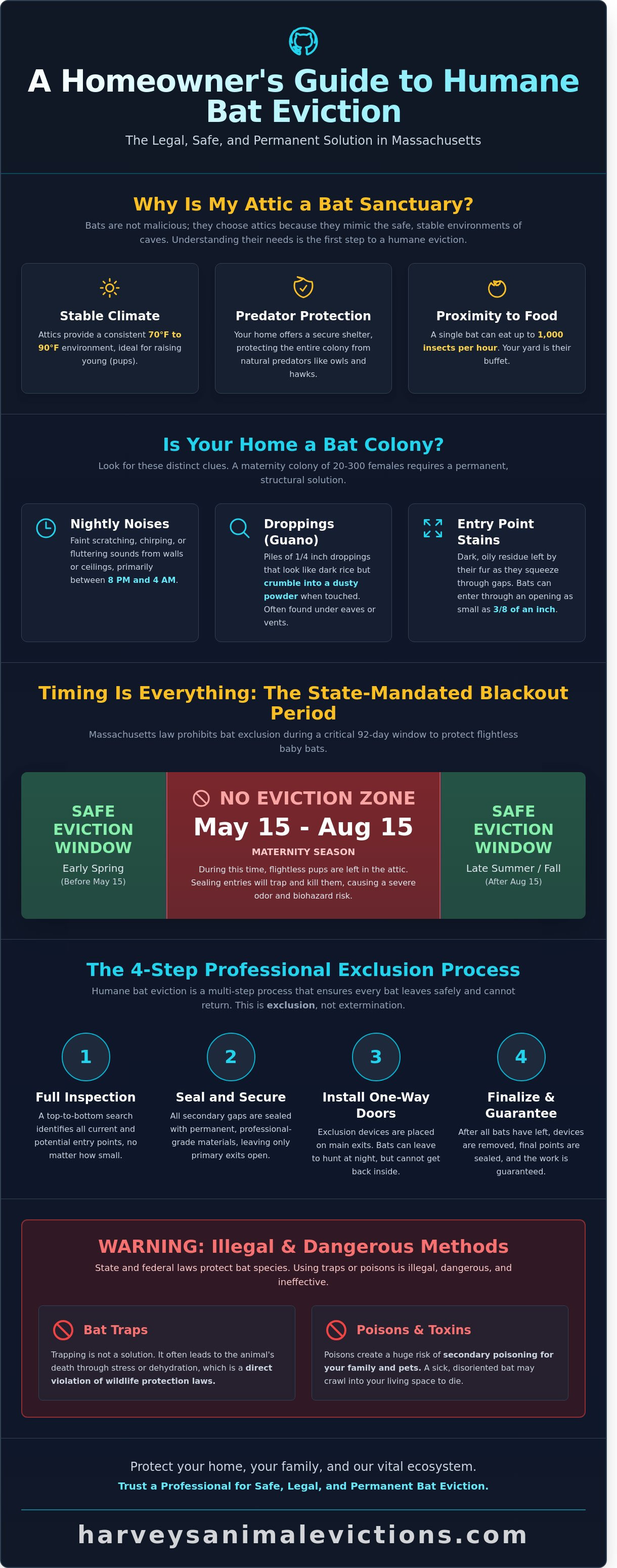
Bats leave distinct clues. You'll often hear scratching or chirping sounds between 8:00 PM and 4:00 AM as they prepare to hunt or return to sleep. Look for guano, which are 1/4 inch long droppings that look like dark rice but crumble when touched; these are typically found on siding or under gable vents. Another major sign is "staining," which is an oily, dark residue left by the sebum on their fur as they squeeze through gaps as small as 3/8 of an inch.
Why Bats Are Protected in 2026
The legal landscape surrounding bats is strict because their survival is at risk. Since 2006, White-nose Syndrome has decimated local populations, killing over 90% of bats in some Massachusetts hibernacula. These animals are vital to our ecosystem; a single bat can consume 1,000 mosquito-sized insects in one hour. Because of this, humane eviction is the only legal solution. We focus on securing your property while respecting the laws that keep our local insect-control experts in the sky.
The Legal and Ethical Landscape of Bat Eviction
In Massachusetts, bats aren't just pests; they're protected neighbors that play a vital role in our local ecosystem. State law is incredibly clear on this point: harming or killing bats is strictly prohibited. Because species like the Little Brown Bat and Northern Long-eared Bat are listed under the Massachusetts Endangered Species Act, any attempt to lethally remove them can result in significant legal penalties. MassWildlife regulates all residential animal removals to ensure that these "unwanted tenants" are handled with the respect they deserve. Professional wildlife specialists are the only ones equipped to manage these situations because they understand the complex intersection of public health and conservation law. Following the Massachusetts guidelines for bat removal is the only way to ensure your property is secured without risking a violation of state environmental codes.
Timing Your Bat Removal
Timing is everything when it comes to bat removal massachusetts. The state mandates a "maternity season" blackout period that typically runs from May 15 to August 15. During these 92 days, exclusion is forbidden. This isn't just a bureaucratic hurdle; it's a practical necessity. During the summer, mother bats leave the colony at night to hunt, but their pups are flightless and remain behind in your attic. If you seal the entry points during this window, the pups will starve and decompose inside your walls. This creates a sanitary crisis and a foul odor that can linger for months. The most effective windows for a permanent fix are in the early Spring or the early Fall. These periods ensure the colony is active but not nursing young, allowing for a clean and humane eviction.
Why Bat Traps and Poisons are Illegal
The concept of a "bat trap" is a dangerous myth. Trapping bats in cages often leads to the animal's death through stress or dehydration, which is a direct violation of state wildlife protections. Poisons are even more problematic. Using toxins in an attic creates a high risk of secondary poisoning for your family and pets. A poisoned bat doesn't die instantly; it often becomes disoriented and crawls into living spaces where a child or a dog might find it. One-way doors are the industry gold standard for 2026 because they allow bats to exit the structure naturally while preventing their re-entry. This method ensures the home is secured without a single animal being harmed. If you're concerned about the legality of your current situation, you can request a professional assessment to keep your home and the local environment safe.
The Risks of Dormant Colonies: Health and Property Damage
Bats are quiet tenants, but their presence leaves a heavy footprint on your home. Bat guano is highly acidic due to its high concentration of uric acid and nitrogen. This chemical composition acts as a corrosive agent that slowly eats through drywall, wood beams, and metal fasteners. Over several seasons, a colony of 40 to 60 bats can deposit enough waste to compromise the structural integrity of your ceiling. In older Massachusetts homes built before 1950, the sheer weight of accumulated guano has been known to cause sudden ceiling collapses, leading to thousands of dollars in emergency repairs.
Beyond the physical weight, bat colonies leave behind pungent pheromones. These scents act as a biological roadmap for wildlife. They don't just guide bats back to their roost; they signal to other opportunistic invaders like raccoons and squirrels that your attic is a safe, inhabited space. Effective bat removal massachusetts requires more than just moving the animals. It requires a complete neutralization of these pheromone trails to prevent a cycle of recurring infestations.
Homeowners often focus on the fear of rabies, but the statistical reality is quite different. Less than 1% of Massachusetts bat species actually carry the rabies virus. While a bite is a medical emergency, the primary health threat in most homes isn't a physical encounter. It's the microscopic pathogens living in the waste they leave behind.
Histoplasmosis and Respiratory Safety
Histoplasmosis is a respiratory infection caused by the fungus Histoplasma capsulatum, which thrives in dried bat droppings. When guano is disturbed, these microscopic spores become airborne and easily inhaled. You should never attempt a DIY cleanup with a standard vacuum or broom. Professional-grade HEPA filtration and specialized PPE are required to handle this material safely. Securing professional attic decontamination is the only way to ensure your family's long term respiratory health after an eviction.
Structural Integrity and Insulation Damage
Bat waste is a silent killer for your home's energy efficiency. As urine and guano saturate fiberglass or cellulose, they destroy the material's R-value, making your heating and cooling systems work much harder. This contamination is worsened by the "chimney effect," where warm air rising through the house pulls contaminated attic air down into your living spaces. For colonies that have occupied a space for more than 12 months, a full insulation replacement is typically the only way to eliminate odors and restore bat removal massachusetts standards of safety.
The Professional Exclusion Process: A Step-by-Step Guide
Effective bat removal massachusetts requires a methodical approach that respects both your property and the local ecosystem. We don't view bats as pests to be destroyed; we treat them as unwanted tenants that need a clear, one-way exit strategy. Our five-step eviction process ensures your home returns to a secure state while maintaining the highest ethical standards.
Step 1: Structural Inspection. We perform a 360-degree assessment of your home's exterior. Our technicians look for entry points as small as 3/8 inch, which is roughly the width of a standard pinky finger.
Step 2: Device Installation. We place professional one-way exclusion devices at the primary exit points. These allow the colony to leave for their nightly feeding but prevent them from re-entering.
Step 3: Secondary Sealing. While the primary exits remain open, we seal every other gap, ridge vent, and soffit. We use wildlife-grade materials designed to withstand weather and animal activity.
Step 4: Monitoring Period. We monitor the site for 7 to 14 days. This window ensures every bat, including those that might have stayed behind for a night, has successfully exited the structure.
Step 5: Final Decontamination. Once we confirm the eviction is complete, we remove the devices, seal the final holes, and decontaminate the space to remove hazardous waste.
Identifying Entry Points
Rooflines, chimneys, and fascia boards are the most vulnerable areas because bats prefer high, secluded spots for roosting. In 85% of our cases, these structural gaps are caused by natural settling or wood rot. To confirm exactly where the colony is roosting, we often perform "night watches." This involves positioning technicians around the perimeter at dusk to document the precise flight paths of the bats. Once identified, we use 1/4 inch galvanized steel mesh, heavy-duty sealants, and custom metal flashing to ensure these gaps never open again.
The One-Way Door Mechanism
The exclusion funnel is a masterpiece of simple physics. Bats are designed to drop into flight or crawl out of tight spaces; however, they cannot hover or land back onto the slick, angled surface of a professional exclusion tube. This method stands as the most humane way to manage a colony because it doesn't separate mothers from pups or cause unnecessary stress. After the 14-day monitoring period, we return for a follow-up inspection. We verify the "eviction" is 100% complete before we apply the final permanent seals to your home.
If you suspect bats have taken up residence in your attic, don't wait for the colony to grow. Schedule your professional bat removal massachusetts today to secure your home.
Securing Your Home with Harvey’s Animal Evictions
Harvey's Animal Evictions LLC serves as the ethical guardian for your home and the local Massachusetts ecosystem. We recognize that finding a bat in your bedroom at 2:00 AM is a high-stress emergency. That's why we provide 24/7 emergency response for bats found inside living quarters. Our team handles these situations with calm authority to lower your anxiety immediately. Transparency is a core value, so we offer either a flat-rate fee or a clear labor-plus-materials breakdown. You won't face hidden costs after the work begins. Our comprehensive seal-up guarantee ensures that once we secure your property, these unwanted tenants cannot return. This commitment to permanent results is why we are a leading choice for bat removal massachusetts homeowners trust.
Our Humane Eviction Philosophy
We view bats as vital contributors to our environment, not pests to be exterminated. Relocating these unwanted tenants without causing them harm is the foundation of our process. Every one of our specialists undergoes 40 hours of annual training specific to Massachusetts wildlife regulations and bat biology. This expertise allows us to identify entry points as small as 3/8 of an inch. Specialists use one-way exclusion devices that let bats exit safely while blocking their re-entry. If you suspect a colony has moved in, schedule a professional inspection today to begin the humane eviction process and get the bat removal massachusetts requires for long-term safety.
Beyond Removal: Restoration and Prevention
The job isn't finished when the last bat leaves. Bat guano can harbor histoplasmosis spores and damage insulation, reducing your home's R-value by as much as 20 percent. Restoration services return your space to a like-new state by removing biohazards and replacing contaminated materials. High-grade steel mesh and architectural-grade sealants are used during exclusion to protect your property value for years. We've secured over 500 homes in the last 24 months, ensuring structural integrity remains uncompromised. Contact us for immediate assistance with any wildlife nuisance to protect your family and your investment.
Secure Your Home for a Bat-Free 2026
Living with bats doesn't have to be a permanent situation for your family. Massachusetts law protects these creatures, so you need a strategy that respects the 2026 legal framework while prioritizing your safety. Dealing with tiny entry points and hazardous guano requires a Licensed Massachusetts Wildlife Specialist to ensure your home's structural integrity remains intact. We've outlined how to identify these unwanted tenants and the specific steps involved in a professional exclusion process.
Our team utilizes humane, non-lethal methods to move bats out without causing them harm. If you find an animal in your living space at 3 AM, our 24/7 emergency service provides the immediate relief you need. Reliable bat removal massachusetts is about more than a quick fix; it's about a permanent eviction that keeps your attic secure for the long term. You shouldn't have to manage the stress of a wildlife intrusion alone.
Take the first step toward a peaceful home. Contact Harvey’s Animal Evictions for a Professional Bat Inspection to start your customized exclusion plan. We're ready to help you reclaim your space with confidence and care.
Frequently Asked Questions
Is bat removal legal in Massachusetts during the summer?
No, you cannot legally perform bat exclusions in Massachusetts between May 1 and July 31. This specific window protects flightless pups that would otherwise starve if their mothers were locked out of the roost. MassWildlife enforces these dates to preserve local populations. If you have an emergency, we can still perform a site inspection and secure your living space while we wait for the legal window to open on August 1.
What should I do if a bat is flying in my bedroom at night?
Close the door to the room and place a towel under the gap to contain the animal immediately. If you woke up with the bat in the room, the Massachusetts Department of Public Health requires the bat to be captured and tested for rabies. Don't release it outside. We provide emergency bat removal massachusetts services to safely capture the unwanted tenant and coordinate with local health officials for the necessary laboratory testing.
How much does professional bat removal and exclusion cost?
A professional bat exclusion for a standard two story home typically costs between $1,500 and $5,000. This price covers the installation of one way doors and the permanent sealing of all secondary entry points. We calculate your specific quote based on the number of linear feet of roofline and the total count of potential gaps larger than 0.25 inches. This investment ensures your home remains secure for years to come.
Can I just wait for the bats to leave on their own in the winter?
Waiting is rarely effective because Big Brown Bats frequently hibernate inside attic spaces where temperatures stay above 35 degrees. They won't simply fly south for the winter. Instead, they'll remain dormant in your walls or insulation until spring arrives. Leaving them in place allows guano to accumulate, which can damage your home's structural integrity and create serious health risks for your family if left unaddressed.
How do I tell the difference between bat guano and mouse droppings?
You can distinguish the two by texture and appearance. Bat guano is usually 0.5 inches long and has a shiny, speckled look from the undigested insect wings. If you crush a piece with a tool, it turns into a fine, metallic powder. Mouse droppings are similar in size but remain hard and don't glisten. Finding large piles of droppings in a single location usually indicates a bat colony's preferred roosting spot.
Will bats return to the same house next year if I don’t seal the entry points?
Bats will almost certainly return to your home because they're creatures of habit with a 30 year lifespan. They follow pheromone trails left by previous colonies to find familiar entry points every season. Even a gap as small as 0.25 inches is enough for them to regain entry to your attic. Our bat removal massachusetts process focuses on permanent exclusion to break this cycle and protect your home from future generations of tenants.
Does homeowners insurance cover bat removal or attic restoration?
Standard insurance policies usually classify bats as vermin and won't pay for the initial eviction or exclusion work. However, many Massachusetts homeowners successfully claim the cost of attic restoration if the guano damage is sudden and accidental. If your insulation requires a full $5,000 replacement due to contamination, we can provide the detailed documentation and photos your adjuster needs to process a potential claim for the cleanup and sanitization.
What are the symptoms of Histoplasmosis I should look out for?
Symptoms of Histoplasmosis typically include a dry cough, chest pain, and a fever that lasts for several weeks. Most people start feeling ill roughly 10 days after inhaling the fungal spores found in bat droppings. If you've been in an attic with significant guano accumulation and experience shortness of breath, consult a doctor immediately. We use HEPA filtered vacuums during our cleanup process to prevent these spores from entering your living space.

Comments